
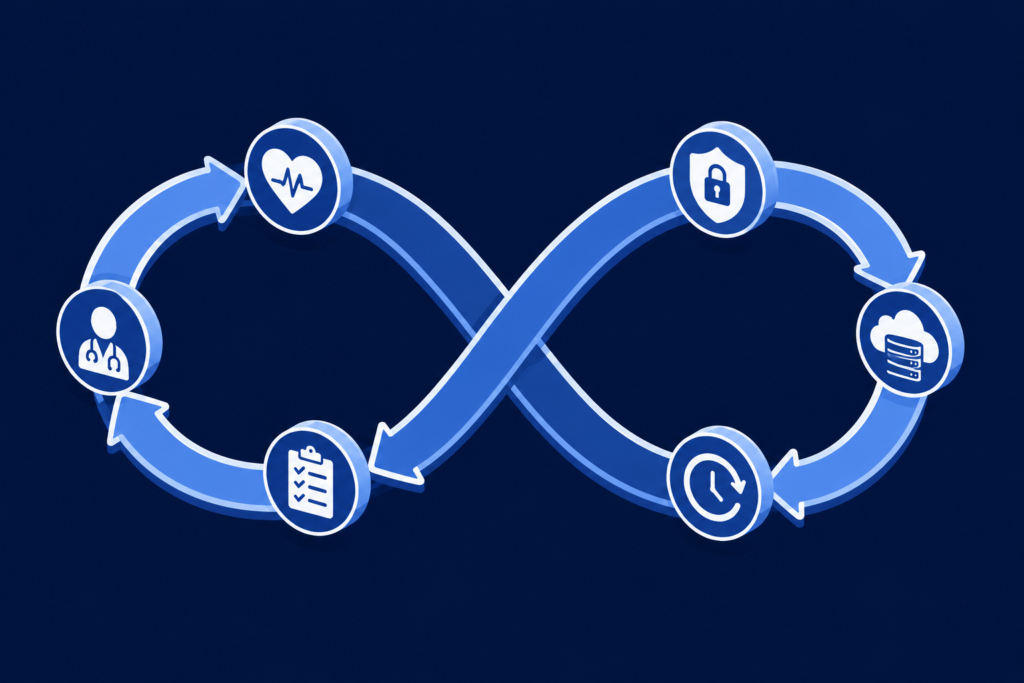
“Continuity of care” gets used constantly in healthcare, almost always in a clinical context – consistent treatment, consistent providers, consistent outcomes for the patient. What gets discussed far less is the technology layer underneath it, even though a break in that layer can disrupt care just as directly as a staffing gap or a supply shortage.
For healthcare providers and aged care organisations, IT infrastructure isn’t a support function sitting quietly in the background. It’s the thing patient records, medication schedules, referral pathways and compliance reporting all depend on being available, accurate, and secure – at every hour of every day, without exception.
Uptime means something different in healthcare
In most industries, a system outage is an inconvenience. In healthcare, it can mean a clinician can’t access a patient’s history during a consultation, a medication round is delayed because the system that tracks it is down, or an aged care facility can’t confirm a resident’s care plan when it matters most.
This changes the calculus around infrastructure decisions. It’s not enough for a system to be reliable most of the time – it needs to be built with redundancy, monitoring, and support that catches problems before they become outages. This is precisely where Managed Services earns its place: proactive monitoring and support that treats uptime as a clinical requirement, not just an operational preference.
Data security is a compliance obligation, not a feature
Healthcare data is among the most sensitive information any organisation holds, and the regulatory environment around it reflects that. Beyond the general obligations every organisation faces, healthcare providers operate under sector-specific requirements around how patient data is stored, accessed, and shared – obligations that don’t ease up as systems age or as staff turn over.
The organisations that manage this well don’t treat security as something bolted onto existing systems after the fact. They build it into the data strategy and architecture from the start – governed access, clear audit trails, and infrastructure designed around the reality that a data breach in healthcare carries consequences well beyond the IT department.
Integration across providers is where most systems actually fail
Patients rarely interact with a single system. A hospital network, a specialist’s practice, a pathology provider, and a patient’s GP may all hold different pieces of the same clinical picture – and when those systems can’t communicate, the person who feels the gap is the patient, waiting for records to catch up with them.
This is one of the most common and most fixable problems in healthcare IT. Legacy systems that were never designed to integrate with anything outside their own walls create exactly this friction. Addressing it doesn’t always mean replacing core clinical systems – often it means building the connective layer that lets existing systems share what they need to, securely and reliably.
Scaling capacity without compromising care standards
Healthcare and aged care demand is rarely static. Seasonal pressure, population growth, and shifting care models all mean infrastructure needs to flex – and for organisations still running on-premise, that flexibility is expensive and slow to deliver.
Cloud Enablement gives healthcare providers a way to scale capacity in step with demand, without the lead time or capital cost of expanding physical infrastructure – while keeping the security and compliance posture that healthcare data requires non-negotiable throughout.
Where this leaves healthcare IT decision-makers
None of the above is really about technology for its own sake. Uptime, security, integration, and scalability are clinical and operational concerns first – the technology is simply what has to be right for those concerns to be met.
Park Lane has spent over 45 years working with organisations for whom system reliability isn’t optional, including healthcare providers and aged care organisations navigating exactly these pressures. Our approach combines deep technical expertise with an understanding of what continuity of care actually demands from the infrastructure supporting it.
If your organisation is weighing any of the challenges above, we’d welcome a conversation about what the right infrastructure looks like for your environment.
Get in touch with the Park Lane team at melbourne@parklane.com.au or call 03 9861 6000.